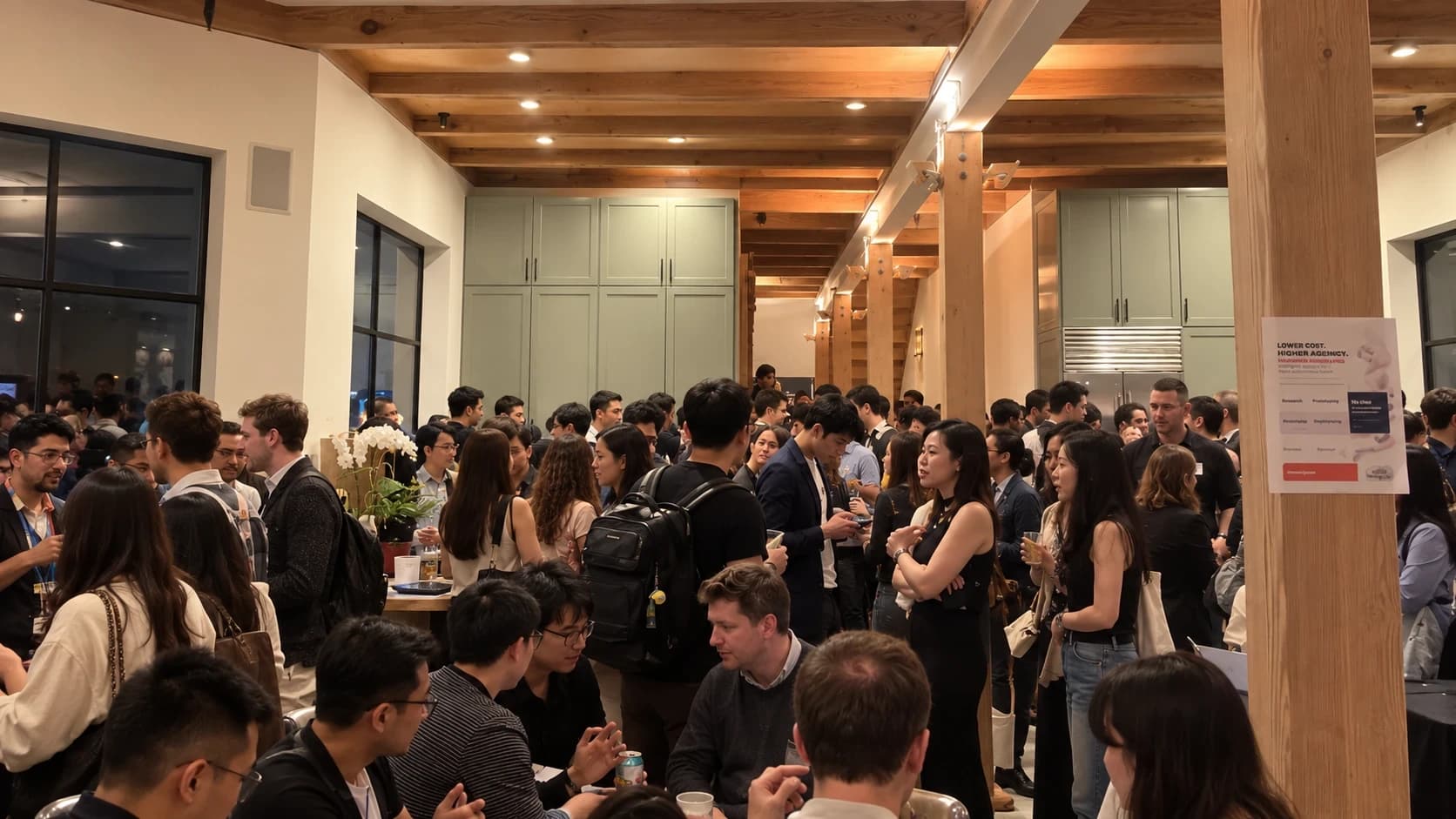

That reframing shaped "The Data Layer of Physical AI," a 100+ person panel on October 6, 2026, hosted at Robotics Center of Silicon Valley during SF Tech Week.
Three vantage points on one stack
The panel covered the data stack end to end: who collects it, who learns from it, and who has already monetized it.
| Speaker | Role | Vantage point |
|---|---|---|
| Jordan Larot | Director of International Business, AgiBot | Robot makers and collection infrastructure: what it takes to produce robot data at scale and sell it |
| Chongxi Lai | Research Lead, Astera | Data-efficient intelligence: how much robot data a better learning architecture actually needs |
| Benoît Koenig | Co-founder and COO, Veesion | Deployed vision at scale: real-time detection across 10,000 stores, with real-world exocentric video now licensed to frontier labs and robotics teams |
Six takeaways
- The shortage is the right data, not more data. Hours are the easiest unit to sell and the weakest predictor of capability. Task diversity and contact-rich interactions are harder to count, but closer to what models actually learn from.
- Go deep before going broad. Depth on a few tasks wins until a policy works reliably. Breadth pays off only once the goal shifts to generalization.
- The cheapest data rarely transfers best. Teleop, handheld grippers, human video and simulation trade cost against fidelity. The most valuable contributors may be domain experts, not the fastest teleoperators.
- Deployment is the best data engine. Failures, interventions and edge cases from real fleets are free at the margin and exactly in-distribution. Teams that instrument from the first pilot compound fastest.
- General models move the value, not remove it. As vision and reasoning models absorb perception and planning, scarce value concentrates in action and contact data, plus real-world context no web dataset holds.
- Raw hours will commoditize; access will not. Durable moats look like continuous access to real deployments, proprietary task coverage, and the curation and evaluation layer on top.
Demand is growing faster than supply
Every team training a generalist policy needs more real interaction data than it can collect in-house, and buyers are starting to pay for it directly. The room showed the signals:
- Data as a by-product becomes a product. Veesion built a real-world exocentric video dataset from its deployed systems and now licenses it to frontier labs and robotics teams.
- Collection is becoming a service. Robotics Center of Silicon Valley (YC S25) sells teleoperation data collection and real-world policy evaluation to robotics teams.
What this means for you
| If you are… | The takeaway |
|---|---|
| A robotics startup | Decide your unit of scale early, and instrument deployments from the first pilot so every failure becomes training data. |
| A data provider | Raw hours will commoditize. Differentiate on task coverage, contact-rich data, curation and evaluation. |
| A model or platform company | Your models already shrink some data needs. Partner where data stays scarce: action, contact and real-world context. |
| An investor | Look for compounding access to real deployments, not one-off dataset sales. |
If you buy, sell or build robot data and want to be in the next closed-door session, get in touch.